

Your Incision Site
Explore three common incision site options for breast implant surgery. Your choices depend on the type of implant, degree of enlargement, your particular body and your surgeon's preference.
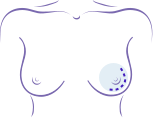
Inframammary Fold Incision
The inframammary incision is made under your breast at the crease, where the breast meets the body. While less concealed, some surgeons find outcomes to be more successful for breastfeeding.

Peri-areolar Incision
The peri-areolar incision is made around the nipple to help conceal the incision site. It involves cutting through the breast tissue and may be associated with the risk of a change in nipple sensation compared to other options.
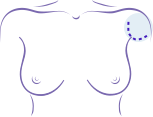
Transaxillary Incision
The transaxillary incision involves using a lighted camera (endoscope) to help tunnel through the area under the arm and create a pocket behind the breast. It's primarily used to place saline breast implants before they're filled.
Your Implant Placement
You'll choose from two common placement options for your breast augmentation.

Submammary/Subglandular Placement
The implant is placed above the pectoral muscle and behind the breast tissue.
CONSIDERATIONS:
- Surgery and recovery may be shorter
- Recovery may be less painful
- May provide easier access for reoperation

Submuscular Placement
The implant is placed partially or wholly below the pectoral muscle.
CONSIDERATIONS:
- Surgery and recovery may be longer
- Recovery may be more painful
- Reoperation may be more difficult
Find Your Mentor Product Match

Your Incision Site
Explore three common incision site options for breast implant surgery. Your choices depend on the type of implant, degree of enlargement, your particular body and your surgeon's preference.
Inframammary Fold Incision
The inframammary incision is made under your breast at the crease, where the breast meets the body. While less concealed, some surgeons find outcomes to be more successful for breastfeeding.
Peri-areolar Incision
The peri-areolar incision is made around the nipple to help conceal the incision site. It involves cutting through the breast tissue and may be associated with the risk of a change in nipple sensation compared to other options.
Transaxillary Incision
The transaxillary incision involves using a lighted camera (endoscope) to help tunnel through the area under the arm and create a pocket behind the breast. It's primarily used to place saline breast implants before they're filled.